Benjamin Bailey VLE
-
Welcome
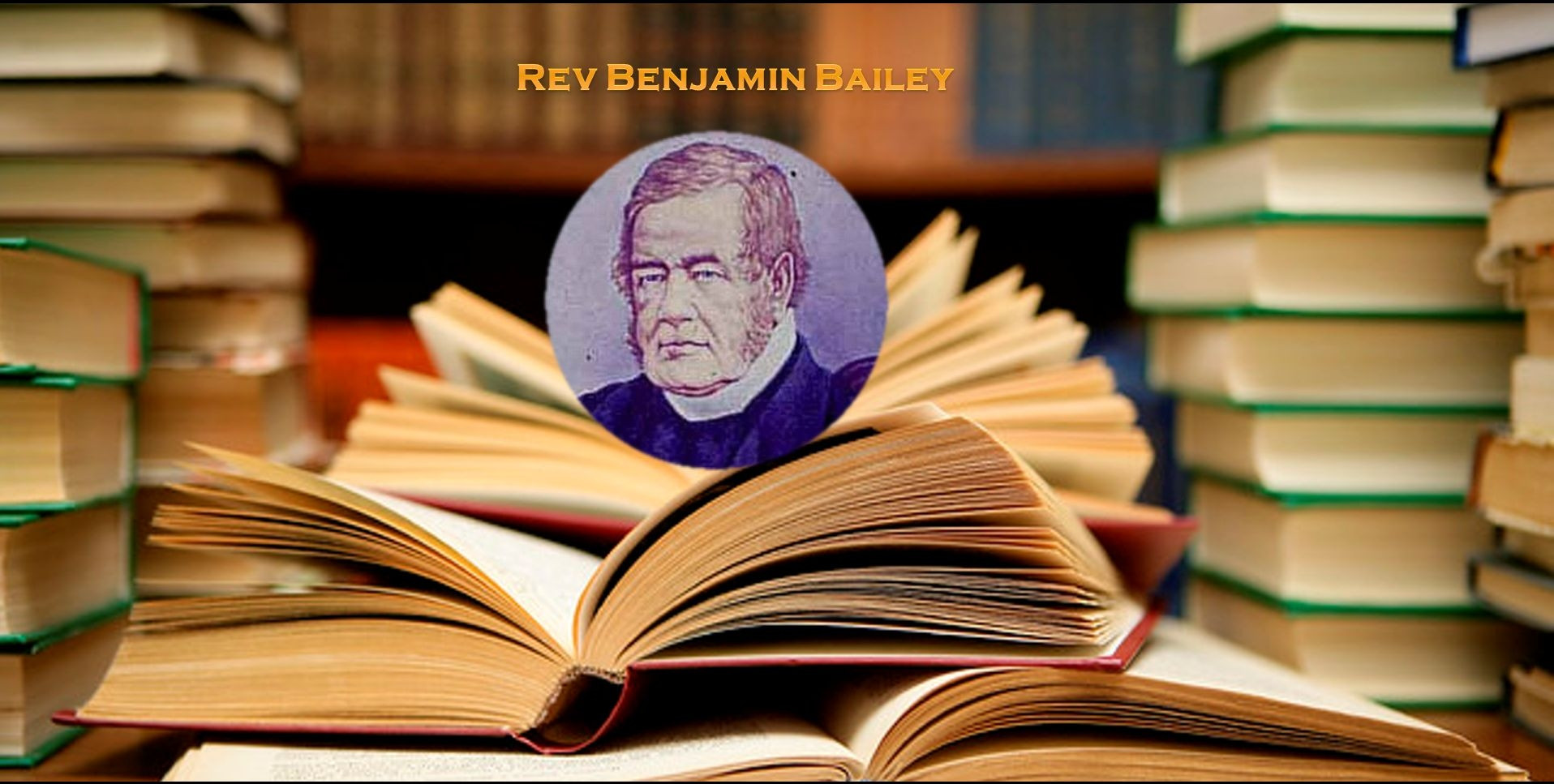
Benjamin Bailey

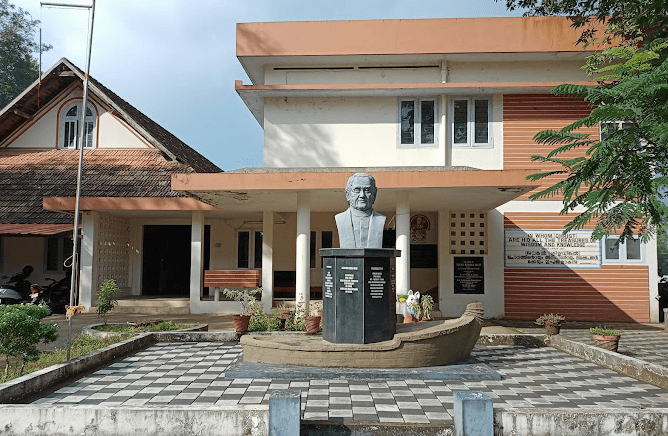
1. Who was Benjamin Bailey?
Benjamin Bailey (1791–1871) was a British missionary with the Church Missionary Society (CMS) who arrived in Kerala (then Travancore) in 1816 and served there for around 34 years. (Wikipedia)
Key contributions:-
First Principal of what became CMS College, Kottayam (from 1817) where he introduced Western-style education (English, mathematics, geography) alongside classical syllabi. (cmscollege.ac.in)
-
Established Kerala’s first Malayalam printing press (CMS Press) in Kottayam in 1821. (Onmanorama)
-
Authored and compiled the first major English-Malayalam and Malayalam-English dictionaries in the mid-1840s. (benjaminbaileyfoundation.org)
-
Translated the Bible into Malayalam, helping standardize modern Malayalam prose. (benjaminbaileyfoundation.org)
-
Designed and standardised Malayalam typography by moulding rounder types for printing. (The New Indian Express)
So Bailey’s work stretches across education, language/printing, culture, and Christian mission.
2. What is the “Kerala Model of Development”?
The Kerala Model refers to the development path of the state of Kerala (India) characterised by relatively high social indicators (education, health, literacy, gender equality) despite moderate per‐capita income and relatively limited industrialisation. (Wikipedia)
Key features:-
Near universal literacy and high human development. (BA (Bachelor of Arts) Hub)
-
Social equity including relatively better female education and health outcomes compared to many Indian states.
-
A long history of missionary and reformer influence, strong state intervention, land reform, decentralisation. (keralacalling.kerala.gov.in)
Hence, the Kerala Model is widely seen as a social‐human development success story, though with caveats on industrial growth and economic base.
3. How did Bailey’s work influence or contribute to this Kerala Model?
Here we map the linkages between Bailey’s contributions and elements of the Kerala Model.
3.1 Education & literacy
-
Bailey’s role as first principal of CMS College (1817) laid the foundation for modern, secular curriculum in the region: “syllabus with Syriac, Sanskrit, Latin, English, Greek, History, Mathematics and Geography”. (cmscollege.ac.in)
-
By setting up the printing press, Bailey enabled production of books in Malayalam, improved access to knowledge, and thus literacy and printed culture. (Onmanorama)
-
Missionary schools, including those influenced by CMS, rapidly expanded across Travancore/Kerala – and missionaries are cited as key to the educational foundations of the region.
Thus, Bailey was an early actor in the chain of events producing high literacy and educational access—a hallmark of the Kerala Model.
3.2 Language, print culture and social change
-
Standardising Malayalam typography, compiling dictionaries, translating major texts: these helped form a modern Malayalam elite and intelligentsia, crucial for social mobility, cultural self‐confidence, and communication. (The New Indian Express)
-
Publishing in local language expands access to knowledge across caste lines; in Kerala’s context, this supported more inclusive education and social reform (which underpins the Kerala Model’s egalitarian tilt).
3.3 Social reform and empowerment
-
While Bailey was a missionary, his educational/printing interventions had spill‐over effects: enabling lower caste / marginalised groups access to literacy and education. For example, sources link missionary schooling to opening access to “underprivileged and the so‐called untouchables”.
-
By promoting education and literacy, his work contributed to social change: questioning caste barriers, enabling new professions, empowering women (through schools). This sets groundwork for the inclusive social policies later associated with Kerala.
3.4 Long‐term institutional foundation
-
The institutions that Bailey helped create (CMS College, CMS Press) continue to exist and contribute to Kerala’s educational infrastructure and cultural heritage. (cmscollege.ac.in)
-
Creation of a knowledge culture (print, dictionaries, translation) in the early 19th century meant Kerala had a head‐start in human development, which later governments built upon.
4. Critical assessment & limitations
While Bailey’s contributions are significant, we should be cautious about attributing the Kerala Model solely or directly to his work. Some caveats:
-
The Kerala Model involves many other factors: princely state reforms (Travancore/Cochin), social reform movements (e.g., Sree Narayana Guru), land reform, left‐wing politics, decentralisation, etc. (Journals Of India)
-
Bailey’s missionary work was focused in the Kottayam/Central Travancore region; the scale of change across all of Kerala took decades and many actors.
-
Economic/industrial dimension: The Kerala Model’s social achievements did not immediately translate into a strong manufacturing base; so while Bailey’s work helped the human development side, it did not directly deliver economic growth or industrialisation.
-
There is debate whether the Kerala Model is entirely sustainable given debt burdens and limited industrialisation. (reddit.com)
Thus Bailey’s work can be seen as one of the foundational pillars of the Kerala Model—particularly on the education/knowledge side—but not the entire story.
5. Specific Impact – Evidence & Data Points
-
The printing press: The first Malayalam printing press in Kerala was established by Bailey in 1821 at Kottayam. (Onmanorama)
-
Modern education: In 1817 he took charge as principal and introduced modern curriculum. (cmscollege.ac.in)
-
Language standardisation: His dictionary publications (1846 English-Malayalam; 1849 Malayalam-English) and Bible translation helped standardise Malayalam prose style. (benjaminbaileyfoundation.org)
-
Broader social effect: According to a state government document: “the activities of the Christian missionaries decisively influenced the expansion and development of health and educational facilities … opening their doors to the underprivileged and the so-called untouchables.”
6. Conclusion
Benjamin Bailey’s work had significant and lasting impact on what later became the Kerala Model of Development, especially in terms of education, literacy, language modernization, and social inclusivity. His legacy lies in creating institutional and cultural foundations (printing press, dictionaries, formal education) that elevated Kerala’s human development capacity.
In the architecture of the Kerala Model, his contributions occupy a critical early layer—the “pre‐industrial, knowledge/social reproduction” layer—upon which subsequent political, social and economic reforms built. Without such a foundational base in literacy, language, print and education, the later achievements of Kerala in health, gender equality and social welfare might have been more difficult.
-